History of 440 Elm
Landmark Venue. Bespoke Experiences. Impeccable Service.
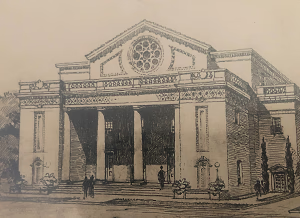
440 Elm's beginnings as the First Church of Christ Scientist, Long Beach
The commercial spirit of our age is so inclined to be a mad race for the 'almighty dollar,' and commercial structures are so often built with the idea of obtaining the most show for the least money that when religious organizations build they should show that their aims are higher. The trend of preachment or sermon in all churches is for the things of lasting value, the real as against the seeming; so when a church builds, it should show that it believes in putting such preachments into practice, that it demands the real in architecture instead of that which only seems so. - Elmer Grey
Elmer Grey built three churches for Christian Science congregations, including the First Church of Christ Scientist, Alvarado Terrace, Los Angeles (1911), the First Church of Christ Scientist, Long Beach (1913), and the First Church of Christ Scientist, Palo Alto (1916).
440 Elm: From Sacred Space to Adaptive Reuse
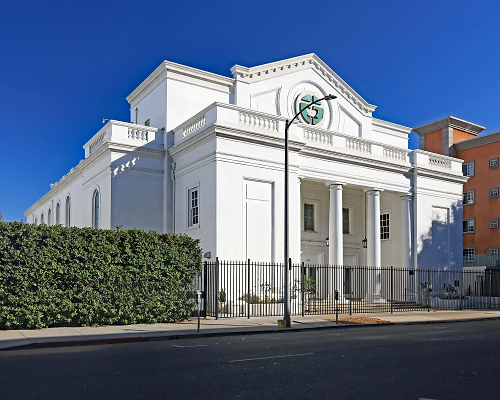
The historic edifice at 440 Elm Avenue in Long Beach represents a fascinating journey from its origins as a house of worship to its current incarnation as a versatile event venue. This Renaissance Revival landmark has stood as a testament to architectural excellence and community gathering for over a century.
Elmer Grey and the Design (1912-1913)
When First Church of Christ, Scientist in Long Beach decided to build a permanent home in 1912, they turned to Elmer Grey, a distinguished architect whose work includes notable buildings across Southern California.1 Grey's selection was fortuitous, as he brought considerable experience in church design and a deep understanding of the specific requirements of Christian Science edifices.
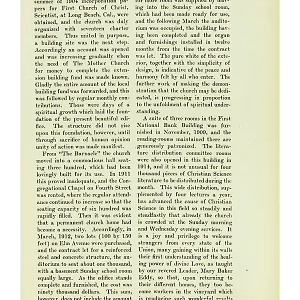
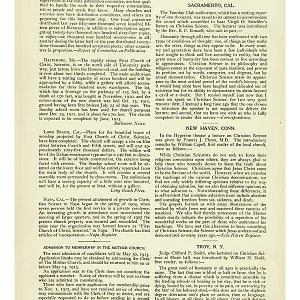
Grey designed the building in the Italian Renaissance style, a choice that reflected the dignified, classical aesthetic favored by many Christian Science congregations of the era.2 The plans called for a brick and reinforced concrete structure with exterior cement facing, measuring 90 by 140 feet. As described in a 1913 article in the Christian Science Sentinel, "In style the church will be of Italian renaissance, and the main auditorium will have a seating capacity of nine hundred and ten persons."3
The architect paid particular attention to acoustics, consulting with acoustical experts from the earliest planning stages. Grey was known to work with companies like H.W. Johns-Manville Company on his projects, as evidenced by their contemporary advertisements referencing his work on other Christian Science churches.4 This careful acoustic design would later prove to be a valuable asset for the building's future use as a performance and event space.
Grey's design incorporated a large main auditorium on the upper level with a Sunday school room of equal size in the basement. The main floor featured an unusually spacious foyer to accommodate the Christian Science practice of congregating after services for conversation.5 The building also included a board room, readers' rooms, and other auxiliary spaces.
Construction and Original Features (1913-1914)
Ground was broken on March 6, 1913, with construction progressing rapidly throughout the year.6 The brick walls were rising by June, and by March 1914, the edifice was complete.7 The building was constructed with high-quality materials throughout, with fine craftsmanship applied to both structural and decorative elements.
The building featured a coffered ceiling in the auditorium, decorative plasterwork, and elegant columns. Large windows provided ample natural light, while the artificial lighting was designed to be both effective and aesthetically pleasing. Like many church buildings of its era, it likely incorporated stained and leaded glass windows.8
Contemporary buildings of this type and quality typically employed advanced building systems for heating, ventilation, and maintenance, which would have been consistent with the standard of excellence evident throughout the structure.9
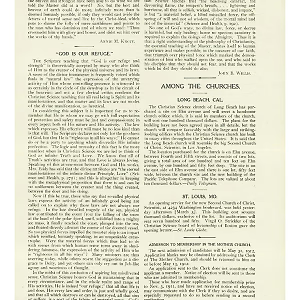
By March 1914, the edifice was complete, a magnificent structure that the Long Beach Press described as "one of the finest edifices in southern California."10 The total cost, including the pipe organ and furnishings, came to approximately $85,000-90,000, not including the $10,000 paid for the lots.11
The Christian Science Era (1914-Late 20th Century)
For many decades, 440 Elm served as First Church of Christ, Scientist, hosting Sunday services, Wednesday evening testimonial meetings, and Sunday school classes. The building was formally dedicated on June 8, 1919, once it was free from debt, in accordance with Christian Science practice.12
The edifice survived the devastating 1933 Long Beach earthquake, though it was temporarily rendered unsafe for occupancy. During this period, the four Christian Science churches in Long Beach held joint services in public parks.13
Throughout the mid-20th century, the building continued to serve its original purpose, standing as a prominent landmark in downtown Long Beach. However, as with many religious organizations in the latter part of the 20th century, membership in the Christian Science church declined, eventually leading to the sale of the building.
Transition and Adaptive Reuse
After its time as a Christian Science church, the building was acquired by First Christian Church, which continued to use it as a place of worship. The architectural integrity of the structure was largely maintained during this period, preserving its historic character.
In recent years, the property at 440 Elm has undergone a transformation into a special event facility while respecting and preserving its historic architectural features. Now operating as "440 Elm," the venue hosts weddings, corporate events, and various gatherings in the heart of downtown Long Beach.
The transformation of 440 Elm represents a successful example of adaptive reuse, preserving a historic architectural gem while giving it new life and purpose in the 21st century. The building continues to serve as a gathering place for the community, much as it has for over a century, though now welcoming a more diverse range of occasions and celebrations.
Elmer Grey's thoughtful design, with its emphasis on acoustics, spacious gathering areas, and elegant aesthetic, has proven remarkably adaptable to modern uses, ensuring that this historic landmark will continue to be a vital part of Long Beach's architectural and cultural landscape for generations to come.
Footnotes
- "The Planning of Christian Science Church Edifices," by Elmer Grey, 1916. ↩
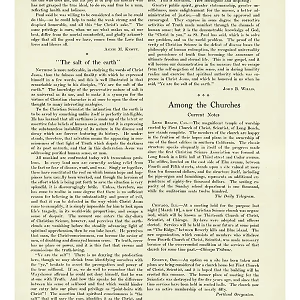
- "Among the Churches," Christian Science Sentinel, March 15, 1913. ↩
- "Among the Churches," Christian Science Sentinel, March 15, 1913. ↩
- H.W. Johns-Manville Co. advertisement in "The Planning of Christian Science Church Edifices," 1916. ↩
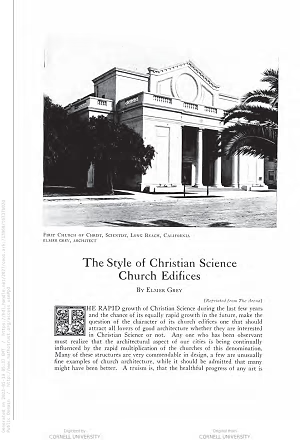
- "The Style of Christian Science Church Edifices," by Elmer Grey, reprinted from The Arena. ↩
- "Among the Churches," Christian Science Sentinel, April 12, 1913. ↩
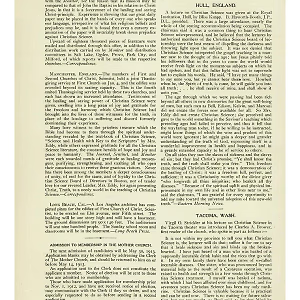
- "Among the Churches," Christian Science Sentinel, June 15, 1913; "Among the Churches," Christian Science Sentinel, April 4, 1914. ↩
- Based on typical features of Christian Science churches of this era and architectural style. ↩
- Inferred from the quality and standards of similar buildings of the period. ↩
- "Among the Churches," Christian Science Sentinel, April 4, 1914. ↩
- "Among the Churches," Christian Science Sentinel, April 4, 1914; "First Church of Christ, Scientist, Long Beach, Cal.," The Christian Science Journal, March 1916. ↩
- "Among the Churches," Christian Science Sentinel, September 20, 1919. ↩
- "Item of Interest," Christian Science Sentinel, April 22, 1933. ↩
Example 440 Elm History Catering Menus
Download PDF: Style of Christian Science Church Edifices
440 Elm History Photos
Earthquake
Plans Completed